Rankings get you found. Recognition gets you recommended.
AI systems evaluate your entire digital presence: your content, your listings, your third-party signals. Then they decide whether your business is a source they can trust. If those signals are scattered or inconsistent, you don’t make the cut.
That’s why AI visibility depends on clarity, consistency, and recognition across your digital ecosystem.
Entity optimization is how you fix that.
An entity is any real-world concept that a search engine or AI system can identify, group, and connect to others. It’s not a keyword. It’s a recognized thing.
For businesses, the most common entities are straightforward:
Google’s knowledge graph contains billions of them.
When a search system encounters your business name, it isn’t just matching text. It looks for a known entity it can clearly describe, link to related ideas, and recommend in the right context.
That’s why entity optimization starts with a simple question: Does Google know what your business is? Not just that it exists, but what category it belongs to, what it specializes in, who’s behind it, and where it operates.
When those answers are clear and consistent across your entire digital presence, machines can build a confident profile. When they aren’t, they guess. Or they move on to a competitor whose signals are cleaner.
Search engines think in relationships, not just keywords.
They evaluate your business name, service categories, locations, content topics, and third-party presence. And they do it all at once.
They compare what your website says against what your Google Business Profile says, what directories say, and what your content signals.
When those sources reinforce each other, machines build a confident picture of your business. When they contradict each other, they don’t.
Entity optimization is the practice of making those signals consistent, connected, and credible. And it does that across every platform that AI systems can see.
It’s not a replacement for
SEO. It’s what makes your SEO visible in AI search.
Sometimes referred to as entity SEO, this process helps AI systems clearly understand:

AI Overviews, ChatGPT, Gemini, and Perplexity don’t rank pages. They select sources they recognize and trust. A business can rank #1 on Google and still be invisible in AI-generated answers.
The brands that get cited aren’t necessarily the biggest. They’re the ones that made it easiest for machines to understand them.
Brand recognition is the strongest predictor of AI citation. It outperforms backlinks, content freshness, and domain authority.
Pages cited in AI Overviews earn a 35% higher click-through rate than non-cited pages on the same results page.

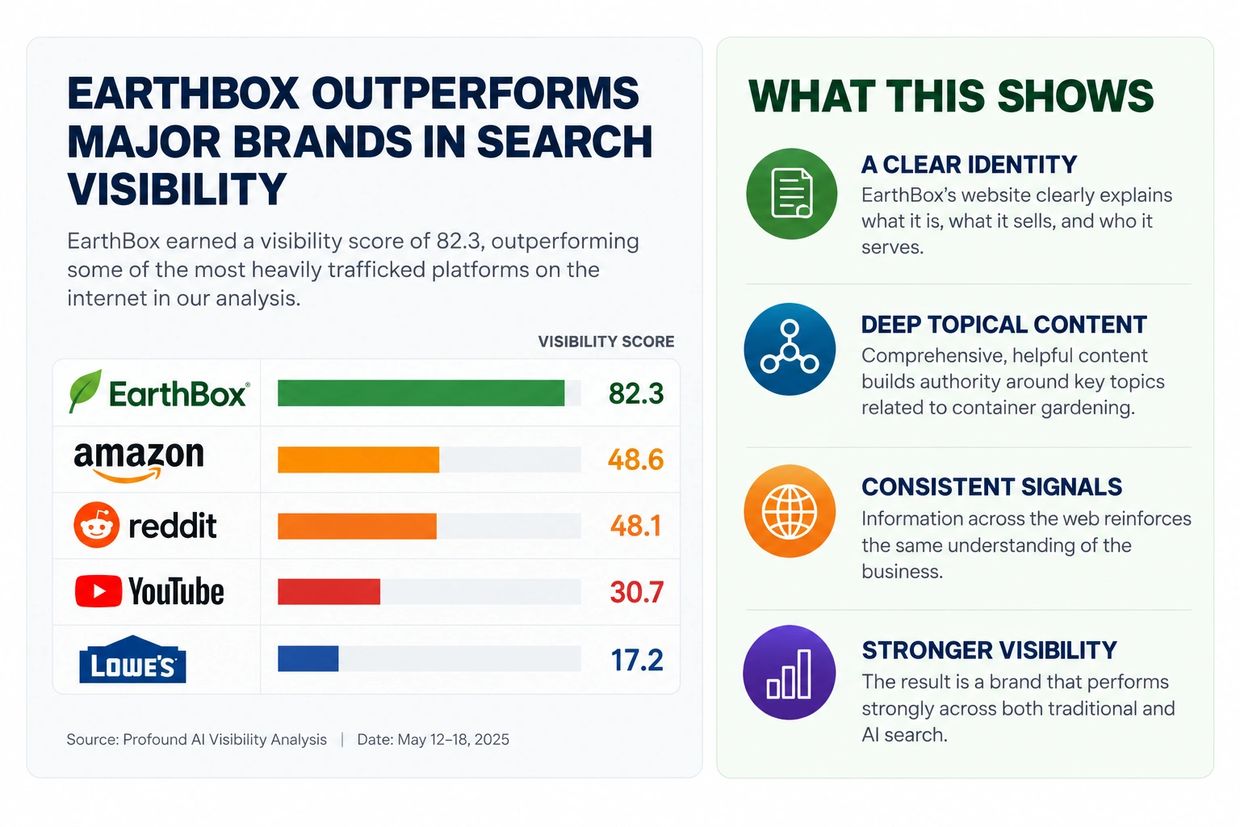
EarthBox earned a visibility score of 82.3 against some of the most trafficked platforms on the internet.
They didn’t outspend them. They out-signaled them with clear entity definition, consistent cross-platform signals, and deep topical authority. That built a profile that AI systems recognized and trusted.
The result was stronger visibility in both traditional search and AI recommendation systems.
Most businesses don’t know their entity signals are working against them. There’s rarely a single obvious failure. It builds gradually, through disconnected decisions made across teams and over time. These are the patterns we see most often.
Any one of these is a signal worth investigating. More than one is a pattern, and patterns incur compounding costs in AI search.
Rankings and AI citation are different evaluations. You can earn one without the other.
Most businesses don’t know their entity signals are working against them. There’s rarely a single obvious failure. It builds gradually, through disconnected decisions made across teams and over time. These are the patterns we see most often.
Any one of these is a signal worth investigating. More than one is a pattern, and patterns incur compounding costs in AI search.
Rankings and AI citation are different evaluations. You can earn one without the other.
Your website, Google Business Profile, and directory listings all say something different. Machines notice.
Inconsistent or thin signals make it hard for search systems to categorize what you do.
Breadth without coherence reads as scattered expertise rather than specialization.
If they're showing up in AI answers and you're not, their entity signals are almost certainly cleaner.

Entity optimization isn’t a single tactic. It’s a system that works because every part reinforces the same picture of your business.
Entity mapping and audit
We start by understanding what machines currently see when they evaluate your business — and where the picture breaks down. That means reviewing your website, Google Business Profile, directory listings, content strategy, and third-party presence as one system.
Schema and structured data
Structured data doesn’t create authority. It confirms the authority your content is already building. We implement a schema that explicitly connects your organization, services, locations, and people. That way, search systems don’t have to infer what they can be told directly.
Topical cluster strategy
A business that clearly demonstrates consistent, interconnected knowledge around a topic becomes recognizable to machines.
We build content ecosystems that signal depth and specialization rather than scattered keyword coverage. It includes pillar pages, cluster articles, and semantic linking.
Topical authority is built when businesses consistently reinforce expertise across interconnected content.
Citation and listing consistency
Small inconsistencies in your business name, address, categories, or service descriptions across directories introduce noise that weakens machine confidence. We audit and align every signal source so they all tell the same story.
Knowledge graph positioning
Machines evaluate businesses by the company they keep. We build third-party connections that place your business within the knowledge graphs AI systems rely on. That means earned mentions, credible citations, and relevant associations.
AI visibility measurement
We track how AI platforms cite, summarize, and recommend your business across ChatGPT, Google AI Overviews, Gemini, and Perplexity. You can see the work compound over time.
We’ll audit your entity signals at no cost and show you exactly what AI systems see when they evaluate your business.
No commitment. Delivered within 5 business days.
What changes is the scope, not the approach.
We’ve built entity authority for local practices in Lancaster and Harrisburg. We've done the same for regional brands, e-commerce companies, professional service firms, and national consumer goods brands.
The signals that earn an AI recommendation are the same regardless of size.
We’ll audit your entity signals at no cost and show you how AI systems currently evaluate your business. We'll determine where visibility may be breaking down, and how stronger signals can improve recognition.
No commitment. Delivered within 5 business days.
Hawkeye Digital Marketing
304 S Mount Pleasant Road, Lebanon, PA 17042
Phone Number:-717-304-9642
www.hawkeyedm.com
Copyright © 2026 Hawkeye Digital Marketing - All Rights Reserved.